
Many industrial facilities continue to rely on disconnected operational technologies
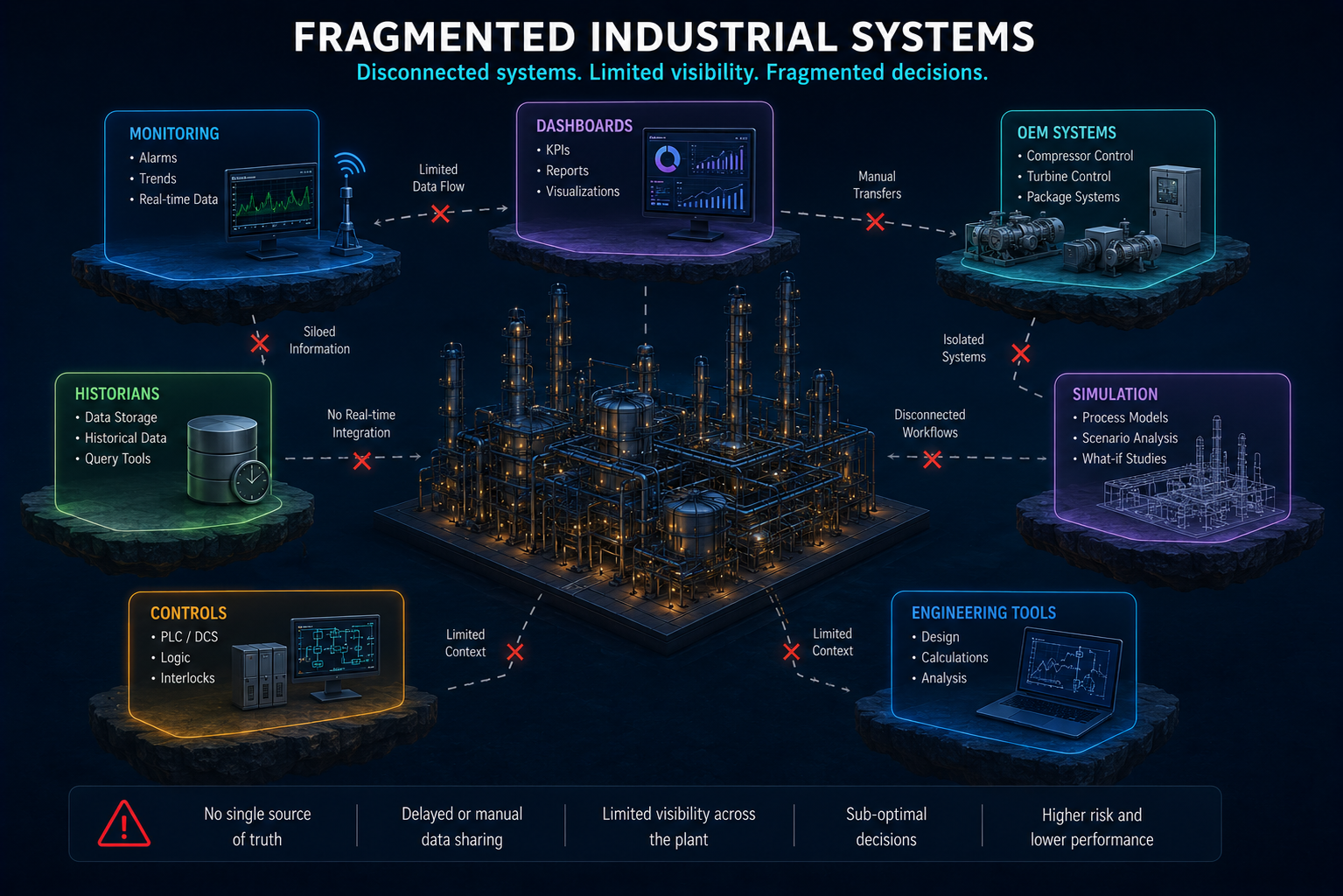
Industrial facilities have historically evolved through separate monitoring systems, simulations, OEM packages, controls, dashboards, historians, engineering applications, and specialist tools developed independently across different operational requirements.
Each of these technologies may provide valuable functionality in its own right. Monitoring systems provide operational visibility. Simulations support engineering analysis. OEM technologies provide machinery-specific information. Controls manage plant response. Dashboards aggregate data. Historians preserve operational records.
Yet despite their value, these systems often remain operationally fragmented, focusing on isolated areas of the plant rather than continuously representing wider plant behaviour across one coordinated environment.
As industrial facilities become more integrated and operationally complex, fragmentation can make it increasingly difficult to understand how the plant is actually behaving.
Plant behaviour extends beyond fragmented operational technologies.
Industrial facilities do not operate as isolated systems
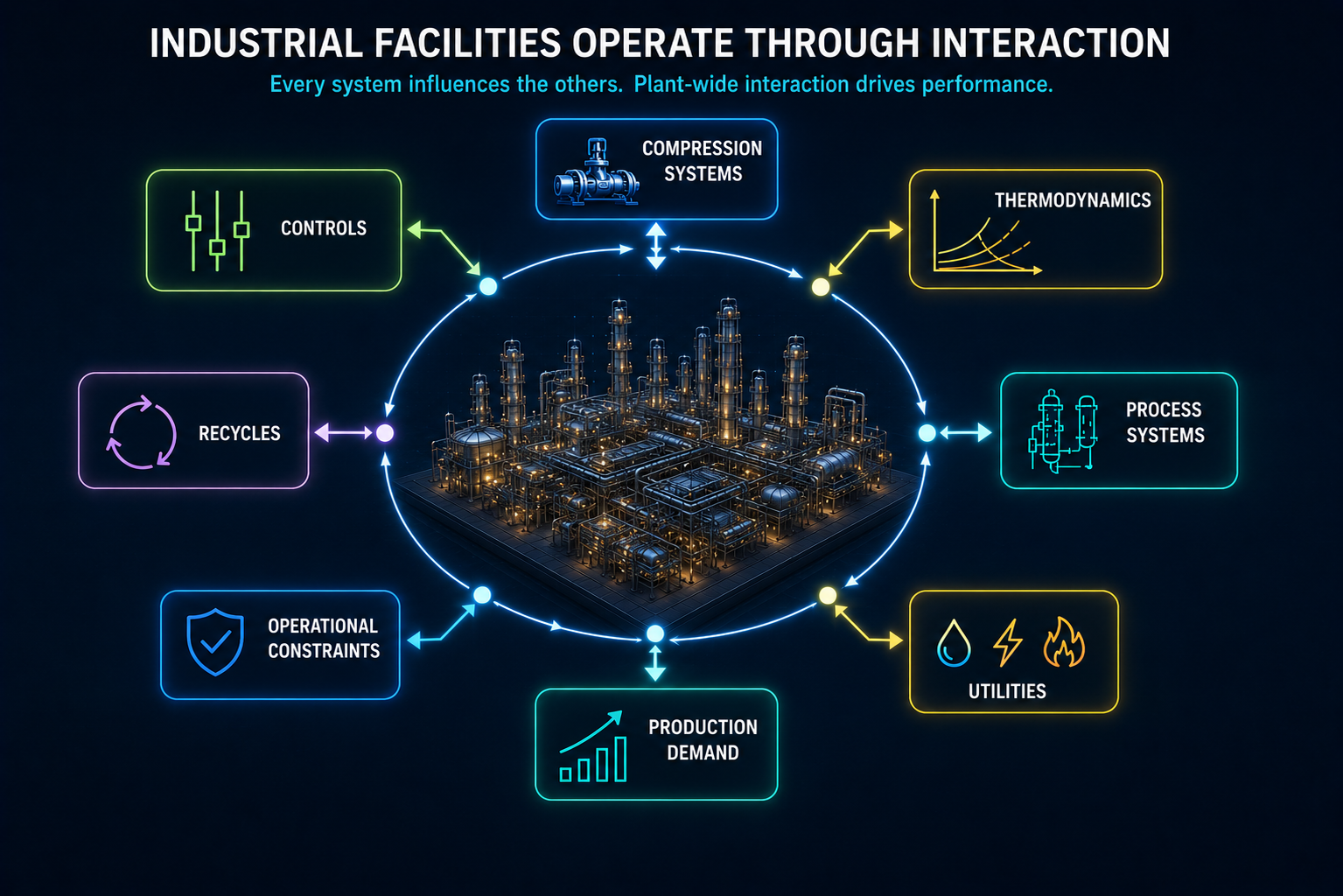
Industrial facilities operate through continuously changing interaction between process systems, machinery behaviour, controls, thermodynamics, recycles, utilities, production demand, operational constraints, and wider plant response.
A change in one part of the plant can propagate across machinery performance, control response, recycle behaviour, thermodynamic state, throughput capability, energy consumption, and plant-wide operational stability.
If the technologies used to understand the plant remain fragmented, operational teams may still have valuable information while lacking a continuously coordinated view of how the facility is actually behaving as one interacting system.
This becomes particularly important across:
- Compression systems
- Anti-surge systems
- Recycle behaviour
- Thermodynamic interaction
- Process constraints
- Production changes
- Remote and unmanned facilities
Industrial facilities require visibility across interaction, not isolated operational islands.
Visibility, monitoring, and analysis lose value when they remain disconnected
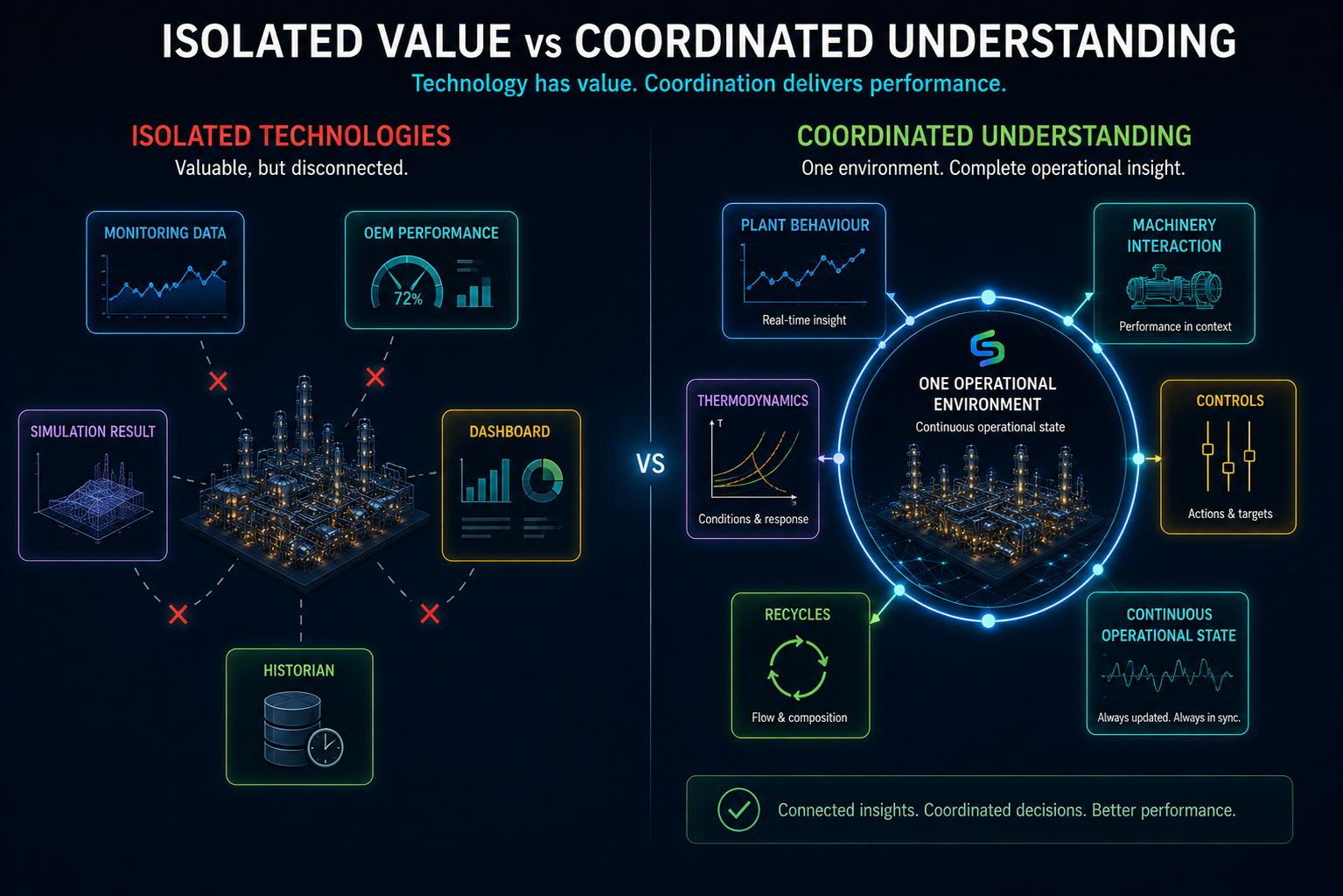
Fragmented operational technologies may still provide valuable information, but their practical value can be limited when they remain disconnected from wider plant context.
A monitoring system may show that machinery performance has changed without explaining how thermodynamics, controls, recycle behaviour, or process interaction contributed to that change.
A simulation may provide useful engineering insight while remaining detached from live operational conditions and changing plant behaviour.
An OEM system may offer detailed machinery information while remaining largely isolated from wider process interaction and plant constraints.
A dashboard may provide visibility into operational data without continuously representing how the plant itself is interacting.
The issue is therefore not that these technologies lack value individually, but that industrial facilities increasingly require them to be related through a wider operational context.
Plant understanding requires more than isolated visibility.
Understanding plant behaviour requires a coordinated operational environment
If industrial facilities operate through continuously interacting plant behaviour, then the systems used to understand them must also be capable of continuously relating those interactions.
This means moving beyond separate monitoring systems, isolated simulations, machinery-only operational views, disconnected dashboards, and fragmented engineering tools toward industrial systems capable of continuously coordinating:
- Monitoring
- Simulation
- Thermodynamics
- Machinery behaviour
- Controls
- Recycles
- Operational visibility
- Wider plant response
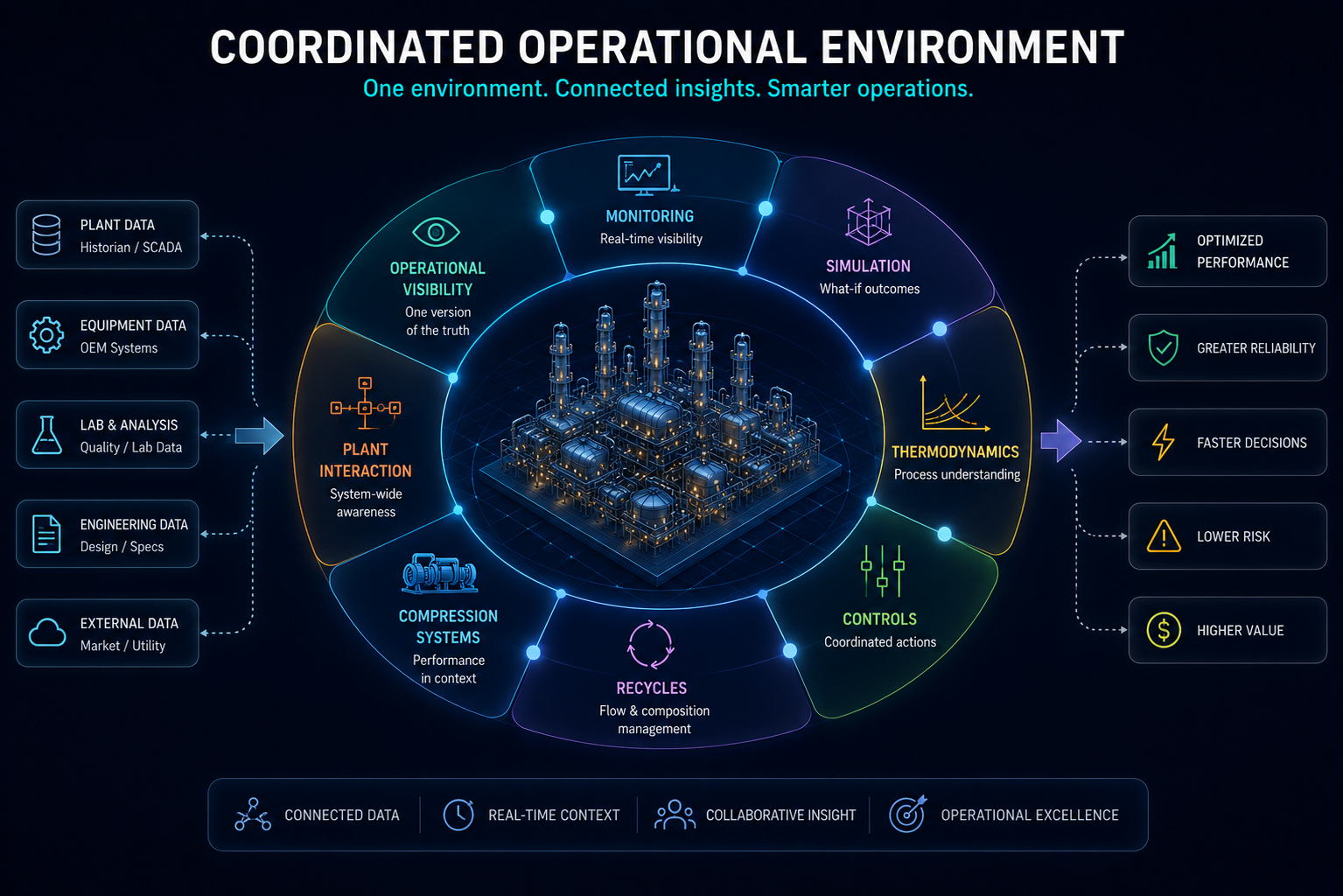
A coordinated industrial system is not simply a collection of connected tools. It is an operational environment designed to continuously represent how the plant behaves across engineering and plant operation.
This is the difference between fragmented visibility and coordinated plant representation.
Plant behaviour requires coordinated systems.
Coordinated industrial systems provide a stronger foundation for plant understanding
Moving beyond fragmented industrial systems does not mean discarding the value of monitoring, simulation, OEM technologies, dashboards, controls, or engineering tools.
It means relating the operational disciplines required to understand the plant within one coordinated operational environment capable of representing machinery behaviour, thermodynamic response, process interaction, recycle behaviour, control response, and wider plant conditions together.
Simulytica was developed around this philosophy.
By continuously coordinating simulation, monitoring, thermodynamics, machinery behaviour, operational visibility, and process interaction within one industrial system, Simulytica helps engineering and operational teams move beyond fragmented operational technologies toward coordinated plant representation across complex industrial facilities.
This creates a stronger foundation for plant-aware machinery operation, wider operational understanding, and viable digital twins across engineering and plant operation.
Beyond fragmented industrial systems lies coordinated plant representation.